
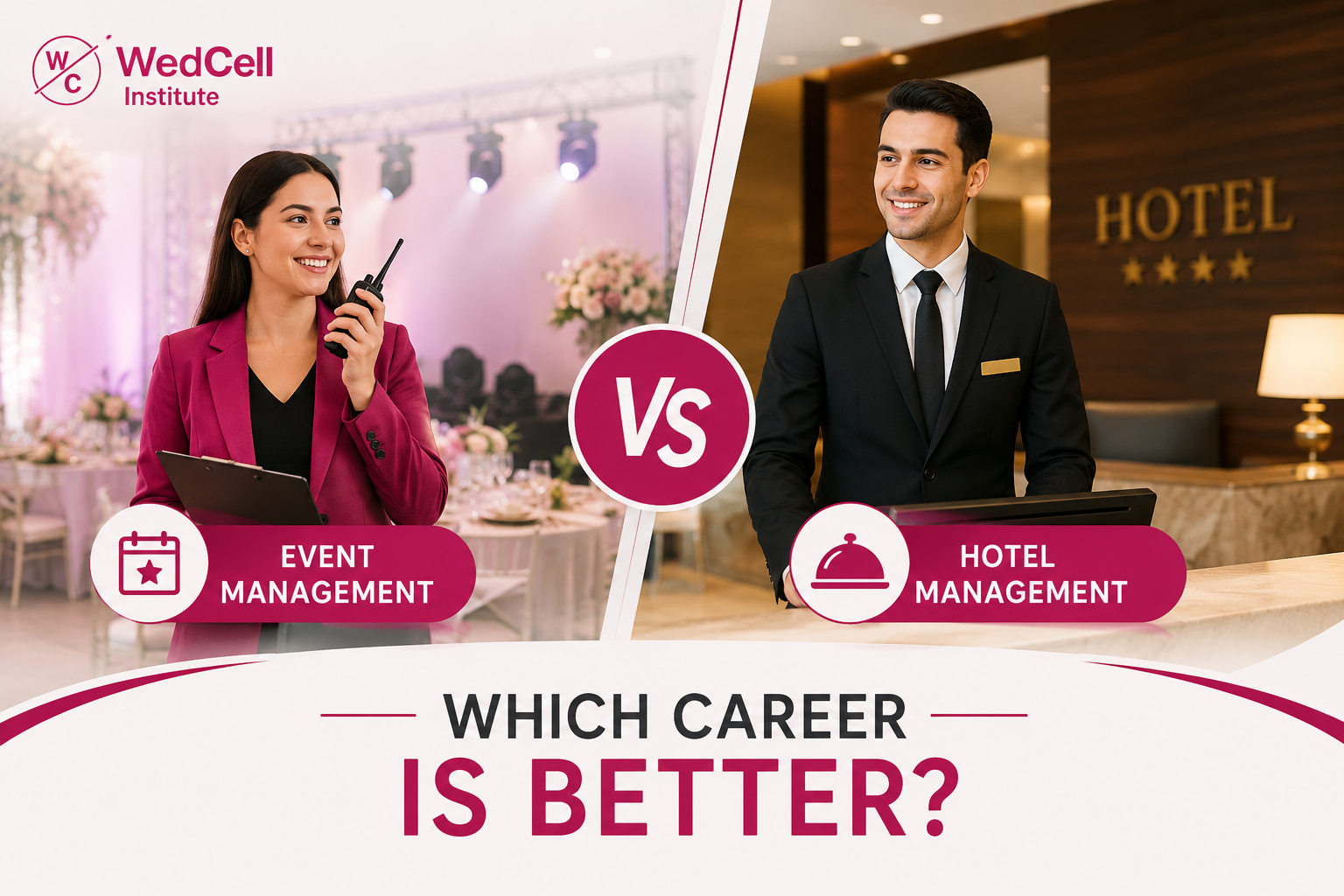
Choosing a career after school or college can be confusing, especially when two fields look interesting and have similar skills. Event Management vs Hotel Management is one such comparison. Both industries are connected with hospitality, people, service, planning and customer experience. But the daily work, career growth, working environment and required skills can be quite different.
If you enjoy organizing weddings, corporate events, concerts, exhibitions or social gatherings, event management can be an exciting career choice. On the other hand, if you like hotels, food and beverage, guest services, travel and hospitality operations, hotel management may suit you better.
So, which career is better: event management or hotel management? There is no single answer for everyone. The better option depends on your personality, interests, career goals and the kind of work environment you prefer.
In this guide, we will compare both careers in simple terms so you can make a more informed decision.
Event management is the process of planning, organizing and executing different types of events. An event manager may work on weddings, conferences, product launches, exhibitions, award functions, fashion shows, concerts, private parties and many other events.
The job is not only about decoration. An event manager may coordinate vendors, artists, caterers, decorators, photographers, venues, transportation and technical teams. They also need to communicate with clients and make sure everything happens according to the planned schedule.
A career in event management can be fast-paced. Every event can bring a different challenge, which is one reason many young professionals find this industry exciting.
Hotel management is about managing the different operations of a hotel or hospitality property. It includes departments such as front office, housekeeping, food and beverage, sales, guest relations and administration.
A hotel management professional focuses on making sure guests receive good service during their stay. They may handle reservations, guest complaints, room operations, restaurant services, staff coordination and other hotel activities.
Unlike event management, hotel management generally involves ongoing operations. A hotel does not operate for just one day. It provides services every day, which means professionals have regular operational responsibilities.
At first, both fields may seem similar because they involve people and customer service. But the nature of the work is quite different.
| Factor | Event Management | Hotel Management |
|---|---|---|
| Main focus | Planning and executing events | Managing hotel operations |
| Work style | Project-based | Continuous operations |
| Common workplaces | Event companies, wedding companies, agencies, venues | Hotels, resorts, restaurants, hospitality companies |
| Major skills | Creativity, planning, negotiation, communication | Guest service, operations, leadership, communication |
| Working hours | Can be irregular, especially during events | Usually shift-based |
| Work pressure | Often high before and during events | Regular operational pressure |
| Career variety | Weddings, concerts, corporate events, exhibitions, etc. | Front office, F&B, housekeeping, sales, guest relations, etc. |
| Creativity | Generally very high | Moderate to high depending on department |
| Travel opportunities | Possible and sometimes frequent | Possible, especially with large hotel groups |
| Client interaction | Very high | High, particularly in guest-facing roles |
The event industry has expanded beyond traditional weddings and parties. Today, companies organize conferences, employee events, brand activations, exhibitions, influencer events, sports events and product launches.
This has created different career opportunities for people interested in event management.
Some professionals start as event coordinators or assistants. With experience, they can move into roles such as event manager, production manager, wedding planner, corporate event planner or event business owner.
One interesting thing about this industry is that experience can matter a lot. A person who has worked on real events and understands vendors, budgets and client handling can develop valuable skills quite quickly.
An event manager may be responsible for planning the event budget, selecting vendors, coordinating teams, creating schedules and handling clients.
For example, a wedding planner may need to coordinate the decorator, caterer, photographer, makeup artist, DJ, venue and hospitality team. If something goes wrong at the last moment, the event manager often has to find a solution quickly.
This makes the profession challenging, but it can also be very satisfying when an event is successfully completed.
A hotel management career offers a more structured path. Students can enter different departments depending on their interests and qualifications.
A hotel management graduate may start in front office, food and beverage, housekeeping or other hospitality operations. With experience, they can move into supervisory and managerial positions.
Large hotel chains can also offer opportunities to work in different cities or countries. Professionals who build strong operational and leadership skills may eventually move into senior management positions.
Hotel management can therefore be a good option for someone who prefers a professional hospitality environment with clearly defined departments and responsibilities.
Education can play an important role in both industries. However, the type of training is somewhat different.
An event management course usually focuses on planning and execution of events. Students may learn about event concepts, budgeting, venue selection, vendor management, event production, marketing, client servicing and event operations.
A hotel management course generally covers hospitality operations. Students may study front office, food production, food and beverage service, housekeeping, hospitality management and guest relations.
| Learning Area | Event Management Course | Hotel Management Course |
|---|---|---|
| Event planning | Strong focus | Limited |
| Wedding planning | Often included | Usually limited |
| Hotel operations | Basic understanding | Strong focus |
| Food & beverage | Useful knowledge | Major subject |
| Guest relations | Important | Very important |
| Vendor management | Very important | Sometimes required |
| Event production | Important | Limited |
| Housekeeping | Limited | Major subject |
| Marketing | Important | Important |
| Practical training | Events and projects | Hotel/hospitality operations |
If your goal is specifically to become an event professional, an event management course can provide more focused knowledge. If you want to work in hotels and hospitality operations, hotel management education may be the more suitable route.
Salary is naturally an important factor when choosing a career. However, there is no fixed salary for either profession. It depends on education, experience, location, company, job role and individual skills.
In event management, beginners may start with entry-level salaries, but experienced professionals can increase their earnings by handling larger events, working with premium clients or starting their own event business.
Hotel management also offers gradual career growth. Entry-level employees may begin in operational roles and move into supervisory and managerial positions with experience.
| Career Stage | Event Management | Hotel Management |
|---|---|---|
| Beginner | Entry-level salary | Entry-level salary |
| 2–5 years | Better opportunities with experience and event portfolio | Growth through department experience |
| Mid-level | Event manager, wedding planner, production roles | Department supervisor/manager |
| Senior level | Senior event manager, agency head, business owner | Hotel department head, senior hospitality manager |
| Entrepreneurship | Event agency, wedding planning, production company | Hotel, restaurant or hospitality business |
Rather than choosing a profession only because of its starting salary, students should look at long-term career growth and personal interest.
A person who enjoys the work is more likely to develop expertise and grow faster in the industry.
If creativity is your biggest priority, event management generally has an advantage.
Every event can have a different theme, audience and objective. An event professional may be involved in creating concepts, stage designs, guest experiences, entertainment plans and unique activities.
Hotel management also needs creativity, especially in areas such as food and beverage, marketing, guest experience and hotel events. However, many hotel roles are more operational and follow established procedures.
So, if you are someone who likes creating new ideas and working on different projects, event management may be a better career choice.
Hotel management can offer a relatively structured employment environment because hotels require employees throughout the year.
Event management can sometimes be more project-driven. Workloads may increase during busy wedding seasons, festivals, corporate event periods or other peak seasons.
However, the event industry is broad. Professionals can work across weddings, corporate events, exhibitions, entertainment and brand activations.
Therefore, job stability depends not only on the industry but also on your skills, employer and ability to adapt.
Neither profession should be considered a typical 9-to-5 career.
Event managers may have long working hours before and during an event. An event can take place late at night, early in the morning or on weekends. The professional needs to be available when the event is happening.
Hotel management is also known for shift-based work. Hotels operate 24 hours, so front office, food and beverage and other departments may require morning, evening or night shifts.
The major difference is that event management can have sudden changes in working hours, while hotel management usually follows a shift structure.
A successful event professional needs more than creativity. Communication and problem-solving are equally important.
| Skill | Why It Matters |
|---|---|
| Communication | Helps with clients, vendors and teams |
| Planning | Keeps the event organized |
| Negotiation | Useful for budgets and vendor contracts |
| Creativity | Helps create memorable experiences |
| Problem-solving | Important when unexpected issues happen |
| Time management | Events run according to strict schedules |
| Teamwork | Large events require multiple teams |
| Budget management | Helps control event expenses |
An event manager also needs patience. Sometimes a client changes requirements at the last minute or a vendor fails to arrive on time. Staying calm and finding a practical solution is part of the job.
Hotel management also requires strong communication and people skills, but operational discipline is especially important.
| Skill | Why It Matters |
|---|---|
| Customer service | Creates a positive guest experience |
| Communication | Essential for guest and staff interaction |
| Leadership | Helps manage hotel teams |
| Organization | Keeps daily operations running |
| Problem-solving | Helps handle guest complaints |
| Teamwork | Hotels depend on multiple departments |
| Attention to detail | Small mistakes can affect guest experience |
| Professionalism | Important in hospitality environments |
People who enjoy helping guests, managing teams and maintaining service standards can do well in hotel management.
Instead of asking which career is universally better, ask which career fits your personality better.
If you enjoy weddings, celebrations, concerts, exhibitions, creative planning and meeting new clients, event management may be a strong option.
If you enjoy hotels, guest services, food and beverage, hospitality operations and structured workplace environments, hotel management could be more suitable.
| If You Prefer… | Consider |
|---|---|
| Creative event concepts | Event Management |
| Weddings and celebrations | Event Management |
| Concerts and entertainment | Event Management |
| Corporate events | Event Management |
| Hotel operations | Hotel Management |
| Guest services | Hotel Management |
| Food and beverage | Hotel Management |
| Hospitality operations | Hotel Management |
| Structured departments | Hotel Management |
| Starting an event business | Event Management |
Yes, event management can be a rewarding career for people who genuinely enjoy planning and working with people.
The industry can be demanding. There can be pressure, deadlines, late working hours and unexpected problems. But there is also variety. You may work on a wedding one month, a corporate conference the next and a large entertainment event after that.
Another advantage is the possibility of entrepreneurship. After gaining experience and building a network, some professionals choose to start their own event planning or production company.
Hotel management is also a strong career option for students interested in hospitality.
It can provide exposure to different departments and give professionals a chance to develop management skills. Working with established hotel groups can also provide opportunities for career progression and, depending on the employer, international mobility.
However, hotel work requires patience and consistency. Guest-facing jobs can involve difficult customers, long shifts and high service expectations.
So, Event Management vs Hotel Management — which career is better?
The answer depends on what you want from your professional life.
Choose event management if you are creative, energetic, comfortable with changing situations and interested in weddings, corporate events, entertainment or event production. It can be an exciting field where every project brings something new.
Choose hotel management if you enjoy hospitality, guest service, food and beverage, hotel operations and a more structured work environment. It can offer a clear professional path across different departments.
Neither career is automatically better than the other. Both require hard work, communication skills, discipline and a willingness to learn.
The most important thing is to select a career that matches your strengths and interests. A good career is not simply the one with the highest salary. It is the one where you can learn, grow and actually enjoy the work you do.
Both are good career options, but the right choice depends on your interests. Event management is more suitable for people who enjoy creativity, planning and events, while hotel management is better suited to people interested in hospitality and hotel operations.
Yes, event management can be a good career in India because there is demand for weddings, corporate events, exhibitions, entertainment events and brand experiences. Skills, experience and networking can have a major impact on career growth.
There is no fixed answer. Salaries vary based on experience, location, employer and job position. Senior event professionals and business owners can earn significantly more, while hotel management also offers opportunities for gradual growth into managerial positions.
Yes, students can pursue event management courses after completing 12th, depending on the eligibility requirements of the institute. Certificate, diploma, undergraduate and other specialized programs may be available.
Yes. There can be considerable overlap, particularly in weddings, conferences, banquets and hospitality events. Hotel professionals may work with event teams, while event professionals often coordinate with hotels and banquet departments.
Choosing between event management and hotel management is an important career decision, but it doesn’t have to be stressful.
Think about the kind of work you want to do every day. Do you want to plan memorable events, work with vendors and create experiences? Or would you rather manage guests, hotel departments and hospitality services?
Once you understand the difference between the two fields, the decision becomes much easier.
Whether you choose an event management course or a hotel management course, your future growth will depend on your skills, practical experience, communication, professionalism and willingness to keep learning.
The industry you choose gives you a starting point. Your skills and effort decide how far you go.