
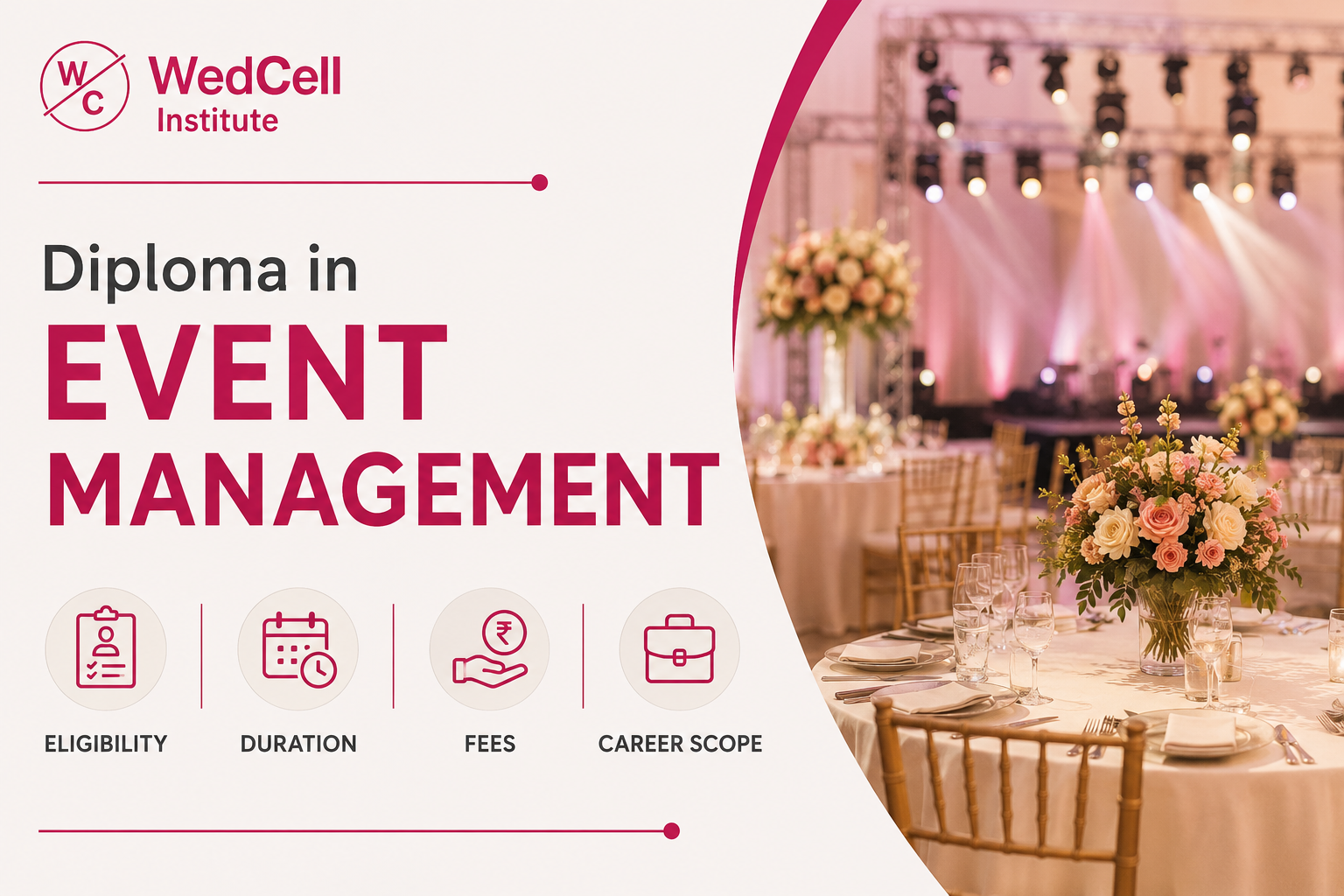
The event industry has changed a lot in the last few years. From big weddings and corporate conferences to music festivals, exhibitions, product launches, college events and private celebrations, people are always looking for professionals who can plan and manage events properly. The career scope after Diploma in Event Management is quite diverse because events are organised across many industries.
Event management is not only about decorating a venue or arranging a party. It involves planning, budgeting, vendor coordination, marketing, communication, guest management and making sure that everything goes smoothly on the actual event day.
Event management is a people-oriented and creative industry. It can be suitable for students who don’t want a completely desk-based career.
The table below gives a quick overview of the course.
| Course Factor | General Information |
| Course Name | Diploma in Event Management |
| Course Level | Diploma / Professional Course |
| Eligibility | Usually Class 10 or 12, depending on institute |
| Duration | Generally 6 months to 2 years |
| Learning Mode | Classroom, practical or blended |
| Main Areas | Planning, production, marketing, budgeting, hospitality |
| Career Options | Event Planner, Event Coordinator, Wedding Planner, Event Executive |
| Workplaces | Event agencies, hotels, wedding companies, corporates, media companies |
| Further Growth | Senior management, freelance work or own event company |
Course structure and eligibility can vary from one institute to another.
The eligibility requirements are generally quite simple. Many institutes offer diploma programmes to students who have completed Class 10 or Class 12. However, the exact requirement depends on the institute and the specific programme.
| Eligibility Factor | What You Should Know |
| Minimum Education | Often Class 10 or Class 12 |
| Stream Requirement | Usually no specific stream |
| Age Requirement | Depends on the institute |
| Entrance Exam | Generally not required for many diploma courses |
| Skills Helpful | Communication, creativity, organisation and teamwork |
| Previous Experience | Usually not necessary for beginners |
Before applying, students should always check the latest eligibility requirements of the particular institute they are interested in.
The subjects can differ from one institute to another, but most programmes introduce students to the main areas of event planning and execution.
| Subject / Area | What Students Learn |
| Event Planning | Planning an event from concept to execution |
| Event Budgeting | Estimating and controlling event expenses |
| Venue Management | Selecting and managing event venues |
| Vendor Management | Finding, negotiating and coordinating with vendors |
| Event Marketing | Promoting events and reaching audiences |
| Client Management | Understanding client needs and expectations |
| Hospitality | Guest experience and service management |
| Event Production | Basic technical and production requirements |
| Wedding Planning | Planning and coordinating wedding functions |
| Event Safety | Understanding basic safety and risk management |
| Public Relations | Communication and maintaining event reputation |
| Digital Marketing | Using online channels for event promotion |
The best part is that these skills can be useful beyond event companies too.
The career scope after Diploma in Event Management is quite diverse because events are organised across many industries.
Here are some common career roles:
| Job Role | Main Responsibility |
| Event Executive | Supports planning and execution of events |
| Event Coordinator | Coordinates people, vendors and event activities |
| Event Planner | Plans events according to client requirements |
| Wedding Planner | Manages wedding planning and celebrations |
| Event Production Executive | Handles production and technical coordination |
| Client Servicing Executive | Communicates with clients and manages requirements |
| Event Marketing Executive | Promotes events through different channels |
| Exhibition Coordinator | Helps manage exhibitions and trade shows |
| Corporate Event Manager | Plans conferences, meetings and corporate events |
| Freelance Event Planner | Handles events independently for clients |
Event management can sometimes be stressful because several things happen at the same time.
| Skill | Why It Matters |
| Communication | Helps in dealing with clients and teams |
| Time Management | Events operate according to strict timelines |
| Creativity | Helps create fresh event concepts |
| Teamwork | Large events require coordination |
| Negotiation | Useful when dealing with vendors and budgets |
| Problem Solving | Helps manage unexpected situations |
| Leadership | Important when handling event teams |
| Budget Management | Keeps the event financially controlled |
| Networking | Helps build relationships in the industry |
| Attention to Detail | Prevents small mistakes from becoming big problems |
You don’t need to be perfect in all these skills when you start. Most of them improve through experience.
Students are sometimes confused between a diploma and a degree. Both have their own advantages.
| Factor | Diploma | Degree |
|---|---|---|
| Duration | Usually shorter | Usually longer |
| Focus | Practical and industry-oriented | Academic + practical |
| Entry | Often easier | May have specific requirements |
| Cost | Generally lower | Usually higher |
| Industry Entry | Faster | Takes longer |
| Suitable For | Quick skill development | Long-term academic route |
The right option depends on your education, career plans, budget and the type of job you want.
Eligibility depends on the institute. Many diploma programmes accept students who have completed Class 10 or Class 12. Some advanced programmes may require Class 12 or graduation.
The duration can vary. A diploma is commonly around 6 months to 1 year, while advanced programmes may take 1–2 years. Always check the specific institute’s course duration.
Fees vary depending on the institute, course duration and facilities. A broad range can be around ₹30,000 to ₹1,00,000 or more, but the exact fee should be confirmed with the institute.
You can explore roles such as Event Executive, Event Coordinator, Event Planner, Wedding Planner, Client Servicing Executive, Event Marketing Executive and Exhibition Coordinator. With experience, you can move into senior roles or start your own business.
It can be a good option for students who enjoy creative work, communication, planning and managing people. However, success depends not only on the qualification but also on practical experience, networking, communication and problem-solving skills.
A Diploma in Event Management can be a practical starting point for students who want to enter the exciting world of events.
The course can introduce you to event planning, budgeting, marketing, hospitality, vendor management and client servicing. More importantly, it can help you understand how an event actually works behind the scenes.
With the right education, practical experience and a strong professional network, you can gradually grow from an entry-level event executive to an experienced event manager, wedding planner, event producer or even an entrepreneur running your own event company.