Starting a career in event management can be exciting, especially for people who enjoy planning, creativity, communication, and working with different people. But there is one thing that can make a big difference between simply learning Event Management Internship and actually understanding it real industry experience.
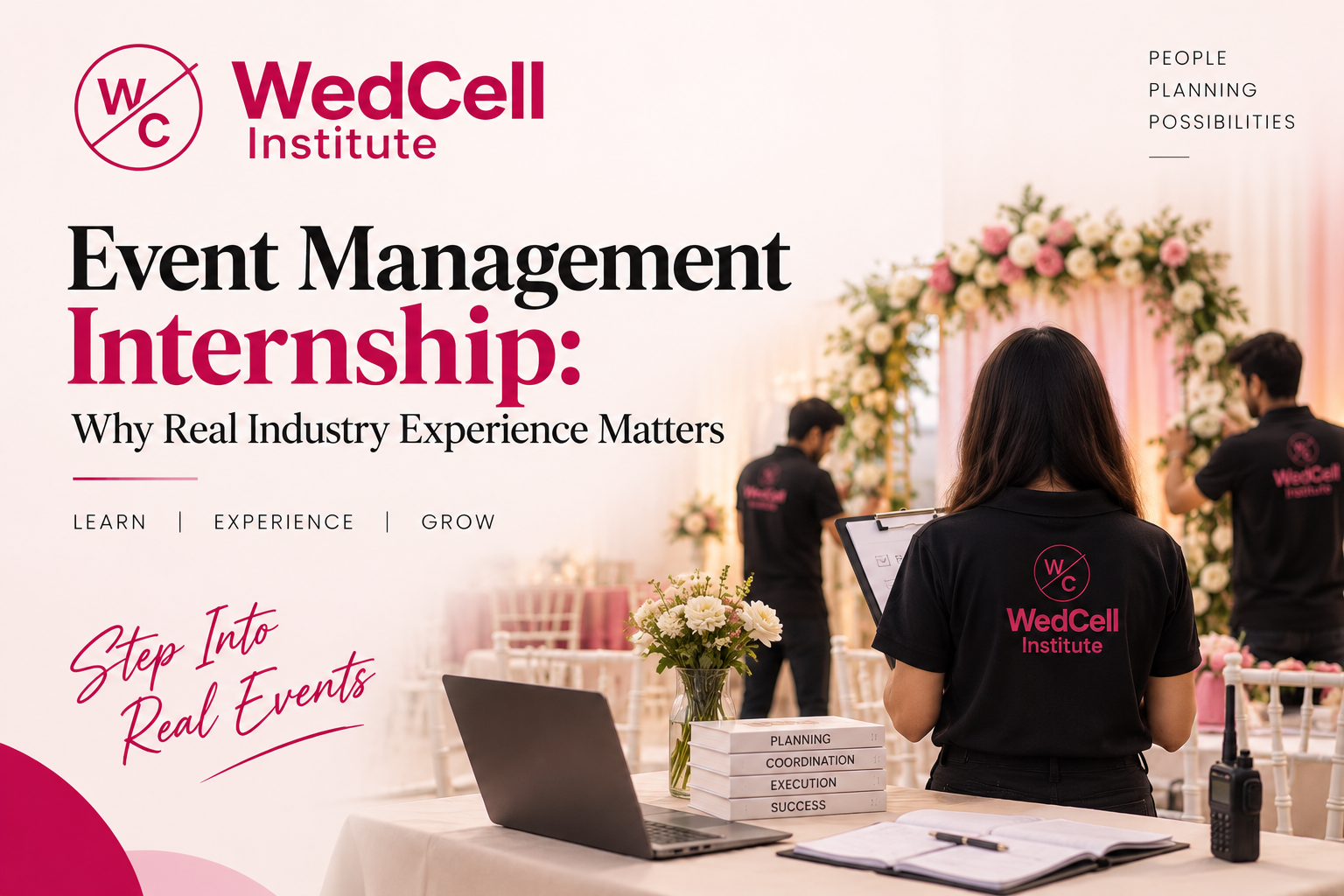
An Event Management Internship: Why Real Industry Experience Matters is important because events are practical by nature. You can learn about budgets, vendors, timelines, décor, production, and guest management in a classroom, but a live event shows you how all these things work together.
An event management internship gives students an opportunity to work with an event company, wedding planner, corporate event team, production company, or other industry professional.
Instead of only studying concepts, interns can observe and assist with real projects.
| Internship Area | What You May Learn |
| Event Planning | Creating schedules and planning activities |
| Vendor Coordination | Communicating with different suppliers |
| Guest Management | Handling registrations and hospitality |
| Décor | Understanding setups and themes |
| Production | Learning about sound, lighting and stages |
| Client Handling | Understanding client expectations |
| Event Execution | Managing activities on the actual event day |
The exact responsibilities depend on the company and project, but even small tasks can provide useful experience.
Classroom learning gives you the foundation. You may understand what event budgeting means or how vendor coordination works.
But when you are standing at a venue and a vendor has not arrived on time, the situation feels very different.
An internship helps students understand how theoretical knowledge is applied in real situations.
The client, venue team, decorators, caterers, photographers, production crew, entertainers, hospitality staff, and event managers all have different responsibilities.
During an internship, you can see how these teams communicate and coordinate.This gives beginners a much better understanding of the complete event process.
An event professional may communicate with clients in the morning, vendors in the afternoon, and the internal team during the event.
An internship allows students to observe how professionals communicate in different situations.
You learn that talking to a client is different from giving instructions to a production team. You also learn how important it is to communicate clearly and professionally.
No matter how carefully an event is planned, unexpected situations can happen.
A supplier may be late. A presentation may not work. A guest may need special assistance. The weather may change an outdoor plan.
Internships allow students to see how experienced professionals respond to such situations.
Instead of only learning about problem-solving as a theory, you can observe how a real team assesses the situation and finds a solution.
This can build confidence over time.
Vendor management is a major part of event planning.
An event company may work with decorators, caterers, photographers, entertainers, transport providers, venues, production companies, and many other suppliers.
During an internship, students can learn how vendors are selected, briefed, coordinated and followed up with.
| Vendor | Possible Coordination |
| Decorator | Theme, setup and timing |
| Caterer | Menu and service |
| Photographer | Schedule and important moments |
| Production Team | Sound, lighting and stage |
| Entertainment | Artist requirements and timings |
| Transport Team | Guest movement and schedules |
These experiences can become valuable event planning skills for future jobs.
Event days can be busy.
There may be several tasks happening at the same time, and some decisions need to be made quickly.
An internship helps students understand what working under pressure actually feels like.
With experience, beginners can learn to prioritize tasks instead of trying to solve everything at once.
This doesn’t mean that every event will go perfectly. In fact, sometimes things will not go according to plan. That’s where experience becomes really useful.
The event industry depends heavily on relationships.
During an event management internship, students may meet planners, vendors, venue managers, photographers, decorators, production professionals, hospitality teams, and other people working in the industry.
These professional connections can help students understand the industry better and discover future opportunities.
Networking should not be about asking everyone for a job. It is more about building genuine professional relationships and learning from people with experience.
Event management has many career paths.
Some students may love wedding planning, while others may enjoy corporate events, production, décor, hospitality, or event marketing.
An internship gives you an opportunity to experience different areas before choosing a specialization.This can help you make a more informed career decision.
An Event Management Internship: Why Real Industry Experience Matters is not simply about adding another line to your resume. It is about understanding the real working environment.
An internship can help students develop communication, teamwork, vendor coordination, time management, problem-solving, client handling, and event execution skills.
Most importantly, it helps beginners understand that successful events are created through planning, teamwork, attention to detail, and the ability to adapt when things change.
An internship gives students practical exposure to real events and helps them understand planning, coordination, vendors, clients, guests, and event execution.
You can learn event planning, vendor coordination, client communication, guest management, production, décor coordination, time management, and problem-solving.
Yes. Students and beginners can look for internships that allow them to learn basic event operations and gradually take on more responsibilities.
Yes. Practical experience can help you develop professional skills, understand the industry, build a portfolio, and create useful professional connections.
Yes. A course can provide structured knowledge, while practical experience helps you understand how those concepts are applied during real events.