When people attend a beautiful wedding, a corporate conference, a music concert or a luxury social event, they mostly see the final result. The decorated venue looks perfect, guests are smiling, food is served on time and everything seems to happen naturally. So, what does an event manager actually do? Is it only about booking a venue and arranging decoration?
Not really. Event management is much bigger than that. An event manager is the person who plans, coordinates, communicates, solves problems and makes sure the complete event moves in the right direction.
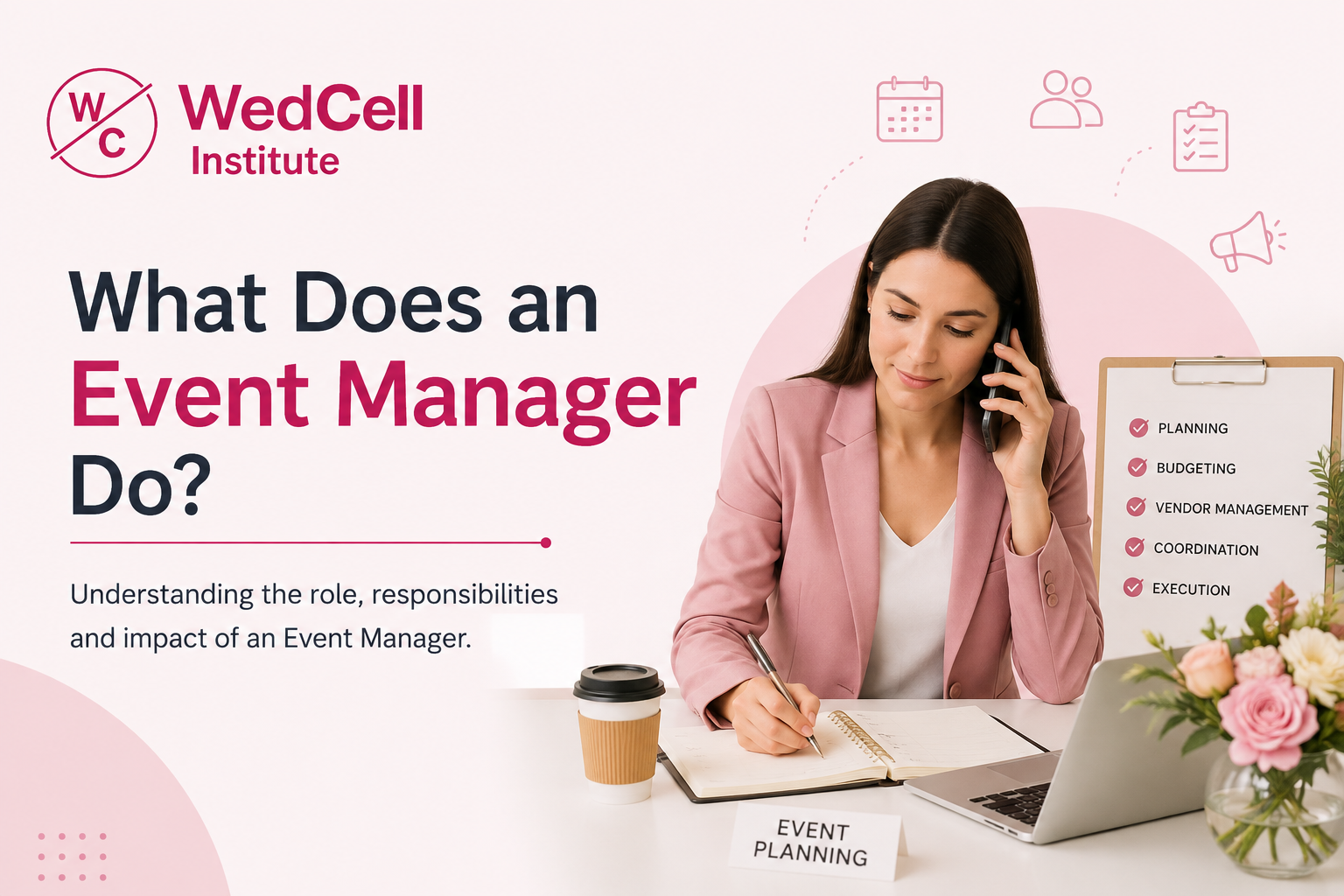
An event manager is a professional who plans and manages an event from beginning to end. Their job is to understand the client’s requirements and then turn those requirements into a practical event plan.
An event manager may coordinate with venues, decorators, caterers, photographers, artists, makeup artists, transportation teams, hotels, technicians and many other vendors.
| Area | What the Event Manager Handles |
| Planning | Event concept, schedule, requirements and timeline |
| Budget | Cost estimation, quotations and expense tracking |
| Venue | Venue research, booking and coordination |
| Vendors | Selection, negotiation and coordination |
| Guests | RSVP, guest communication and hospitality |
| Production | Sound, lights, stage and technical requirements |
| Decor | Theme, setup and decoration coordination |
| Team | Assigning responsibilities and supervising staff |
| Event Day | Managing execution and solving problems |
| Post-event | Vendor closure, feedback and final reporting |
This is why an event manager needs to be both creative and organised. Having good ideas is useful, but knowing how to execute those ideas is even more important.
The responsibilities of an event manager can change depending on the type of event and the organisation they work for. A wedding event manager may spend more time with families, decor teams, hotels and guest arrangements. A corporate event manager may work more closely with companies, speakers, branding teams and production agencies.
Still, most event professionals follow a similar process.
Everything normally starts with a conversation.
The event manager first needs to understand what the client actually wants. Sometimes clients know exactly what they want. Sometimes they only have a rough idea.
For example, a client may say, “We want a royal wedding with a modern touch.”
After understanding the requirements, the event manager starts creating a plan.
This can include the event schedule, vendor requirements, estimated costs, production requirements, guest arrangements and responsibilities of different team members.
Without a proper plan, even a talented team can become confused.
Money is another major part of event management.
A beautiful idea is not always a practical idea if the budget does not support it.
An event manager may need to prepare estimates, compare vendor quotations, negotiate prices and track expenses.
Sometimes a client may prefer to spend more on entertainment and less on decor. Another client may want luxury decor but a simple menu.
Venue selection is also an important part of event planning.
An event manager doesn’t only look at whether a venue is beautiful. They also consider practical things.
Is there enough parking? Where will the guest entry happen? Is the kitchen suitable? Where will the stage be placed? Is there a loading area for vendors? Where can technical equipment be installed? Are there restrictions on music or production?
An event manager watches the timeline and coordinates different teams so the program stays on track.
Of course, real events are usually much more detailed.
The event industry is much wider than weddings.
An event professional can work in different categories.
| Event Type | Common Responsibilities |
| Weddings | Planning, decor, hospitality, entertainment |
| Corporate Events | Conferences, meetings, launches |
| Exhibitions | Stall coordination and visitor management |
| Concerts | Artist, production and crowd coordination |
| Social Events | Birthdays, anniversaries and celebrations |
| Destination Events | Travel, accommodation and guest logistics |
| Brand Events | Promotions, launches and experiences |
| Award Functions | Stage, production, guests and show flow |
This variety is one reason people choose event management as a career.
You don’t necessarily have to spend your entire career doing the same type of event.
They plan the event, understand the client’s requirements, manage budgets, coordinate vendors, organise teams, supervise logistics and make sure the event runs smoothly.
An event manager has to think ahead, communicate with different kinds of people and stay calm when unexpected things happen.
Every event teaches something new. One event may teach you better budget management. Another may improve your negotiation skills. A difficult event can teach you how important backup planning really is.
If you are someone who enjoys creativity but also likes planning, meeting people, solving problems and working in a fast-moving environment, event management can be a very interesting career choice.
An event manager plans, coordinates and executes events. Their responsibilities can include client communication, budgeting, venue management, vendor coordination, guest management, event production, scheduling and solving problems during the event.
Important skills include communication, organisation, creativity, time management, negotiation, leadership, problem solving and attention to detail. Practical experience is also very valuable because event management is highly execution-based.
Event management can be a good career option for people who enjoy planning, creativity, communication and working in a fast-paced environment. There are opportunities in weddings, corporate events, exhibitions, concerts, destination events, brand activations and other celebrations.
A course is not the only way to enter the industry, but professional training can help beginners understand event planning, budgeting, vendor management, hospitality, marketing and event execution in a structured way. Internships and live-event experience can add significant value.
The terms are often used for similar roles. Generally, an event planner may focus more on planning and preparation, while an event manager can have wider responsibility for both planning and live execution. However, job responsibilities vary between companies.