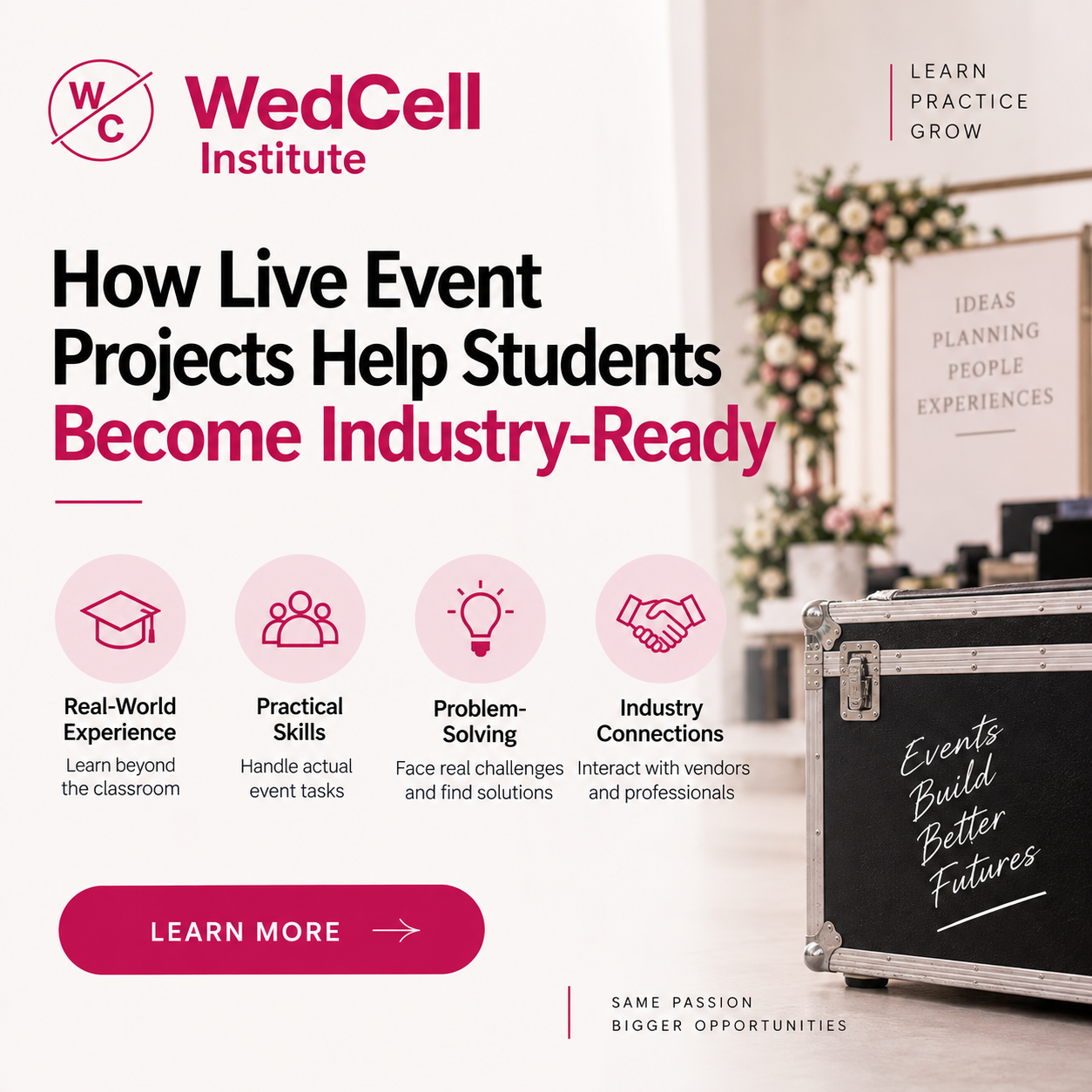
The event management industry looks exciting from the outside. There are beautiful weddings, corporate events, concerts, exhibitions, launches and large celebrations. But behind every successful event, there is a team working on hundreds of small details. For students, learning event management only through classroom theory is not always enough. They need to understand How Live Event Projects Help Students Become Industry . This is where live event projects become extremely valuable.
When students participate in real projects during their course, they get the opportunity to learn by doing. They make decisions, solve problems, communicate with different people and understand how an event comes together from planning to execution.
Live event projects are practical assignments where students get exposure to actual events or realistic event situations. Instead of simply discussing an event in a classroom, students become part of the planning or execution process.
| Classroom Learning | Live Event Project |
| Students learn concepts | Students apply those concepts |
| Practice may be simulated | Experience can happen in real settings |
| Focus is mainly on knowledge | Focus is on knowledge + execution |
| Mistakes are discussed | Students learn to solve problems |
| Limited interaction with vendors | Exposure to different event professionals |
| Fixed academic deadlines | Real event deadlines and schedules |
Books and lectures can explain the steps involved in event planning, but a live project shows students how those steps work together.
For example, a student may learn that venue setup needs to be completed before guests arrive. During a live event, they understand why even a small delay can affect décor, catering, photography and guest movement.
A student may know how to create an event plan on paper but still feel nervous when speaking to a vendor or managing guests.
When students repeatedly participate in events, they become more comfortable communicating with different people. They learn how to introduce themselves professionally, ask questions, share instructions and handle unexpected situations.
Events are rarely managed by one person. A successful event normally involves planners, decorators, caterers, photographers, production teams, venue staff, entertainers, technicians and many other professionals.
Students working on live projects get to experience this teamwork first-hand.
If a wedding starts at 7 PM, the stage cannot be completed at 7:15 PM. If guests are arriving at 6 PM, registration cannot still be getting organised at 6:30 PM.
Through live projects, students experience deadlines in a practical way. They understand how to prioritise tasks and why certain work needs to be completed first.
This experience can help students become more organised and responsible in their future jobs.
One of the most valuable things students learn from live events is that not everything goes according to plan.
A vendor may arrive late. A guest may have a special request. Equipment may not work properly. The weather may change. A speaker may arrive late. Décor requirements may change at the last moment.
An event professional may have to communicate with a client in the morning, coordinate with a decorator in the afternoon and manage a guest or vendor during the event.
Live projects provide students with opportunities to practice professional communication in different situations.
They learn that communication is not only about speaking. It also includes listening carefully, understanding instructions, asking the right questions and keeping everyone informed.
Being industry-ready does not mean knowing everything before getting a job. The event industry is constantly changing, and professionals continue learning throughout their careers.
Industry-ready students are those who understand the basics, communicate professionally, adapt to situations and are willing to learn.
They also help students understand something very important: events are not just about making things look beautiful. They are about planning, people, timing, coordination and execution.
Students should treat every live project as a learning opportunity rather than simply another course activity.
Before an event, they can understand the schedule and their responsibilities. During the event, they should observe how experienced professionals work. After the event, they can think about what went well and what could have been handled better.
Keeping a simple record of projects can also help students build their professional portfolio over time.
Most importantly, students should not be afraid of making small mistakes. In a supervised learning environment, mistakes can become useful lessons for the future.
Live event projects allow students to apply classroom knowledge in practical situations. They can develop skills such as teamwork, communication, time management, coordination and problem-solving.
They can strengthen a student’s practical profile. Employers often value candidates who can demonstrate that they understand how event operations work and have some practical exposure.
Students can develop communication, teamwork, planning, time management, client handling, problem-solving, coordination and professional behaviour.
Yes. Exposure to different event functions can help students discover whether they prefer wedding planning, corporate events, production, décor, hospitality, marketing or other areas.
They are not a replacement for classroom learning. Both are important. Classroom education provides concepts and knowledge, while live projects give students an opportunity to apply those concepts in practical situations.
How Live Event Projects Help Students Become Industry-Ready can be understood in one simple way: students learn much more when they get an opportunity to actually do the work.
Live projects expose students to real schedules, real teamwork, professional communication and unexpected challenges. They help turn theoretical knowledge into practical skills.
For anyone planning a career in event management, this kind of experience can make the transition from student life to professional life much smoother.
A classroom can teach you how an event should be planned. A live event can teach you what it actually takes to make that plan work.