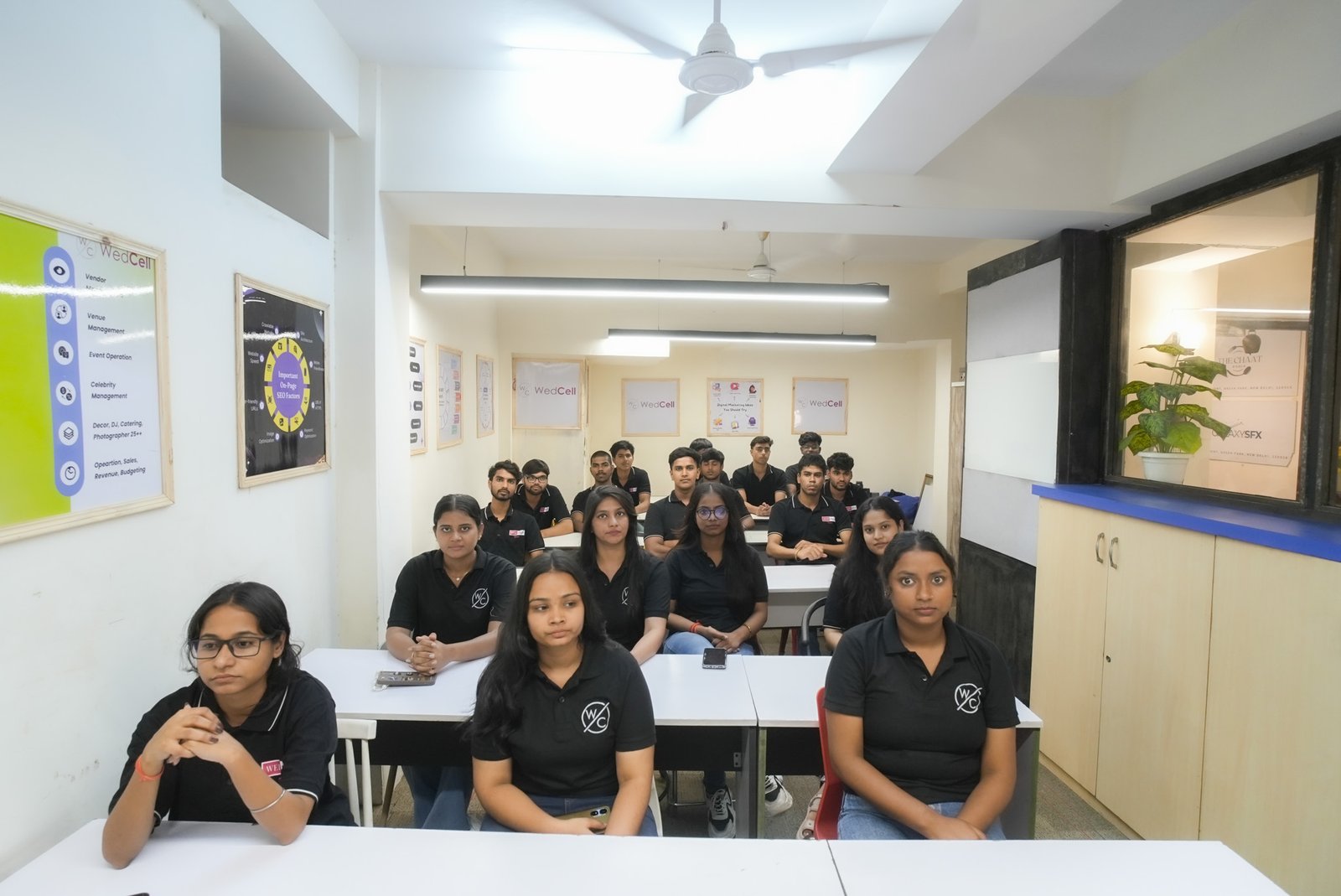
The WedCell Institute of Event Management courses in Delhi after 12th (hereafter “WedCell Institute”) is an educational institute based in New Delhi, specialising in event management, wedding planning and related creative/hospitality fields. It was founded in 2015, and has built a reputation in the Delhi/NCR region for offering event-management training.
Here’s a breakdown of what the institute offers, how it works, the eligibility, course structure, career prospects, strengths and some considerations — all tailored for you if you have just completed 12th grade and are exploring event-management courses.
Before diving into details of the institute, it is helpful to understand why someone who has completed 12th (in any stream) might consider a course in event management:
Event management in India (and globally) is growing: weddings, destination events, corporate/brand activations, exhibitions, entertainment shows are increasingly professionalised.
The role blends creativity + planning + operations + communication. If you enjoy coordination, logistics, design, marketing, this can be a good fit.
It offers varied career paths: from wedding-planner, corporate event coordinator, MICE (Meetings, Incentives, Conferences, Exhibitions) specialist, to starting your own event company.
For a 12th-pass student, it can be a direct entry into a diploma or certificate level course (rather than waiting for a full degree); thus you can start gaining skills early.
Hence, if you’re motivated and interested in “events” — the organisation, conceptualisation and execution of gatherings — a course like those at WedCell Institute can be a viable option.
At WedCell Institute, several programmes are offered. Below are the ones most relevant for a student who has just completed 12th grade.
| Course | Duration | Eligibility | Key Focus |
|---|---|---|---|
| Diploma in Event Management | ~ 6 months (for some short-courses) to 1 year | 10+2 (any stream) | Basics of event industry, planning, coordination, vendor & logistics, practical exposure. |
| Diploma in Wedding Planning | ~ 1 year | 10+2 (any stream) | Focused on weddings: themes, décor, budgeting, vendor management – a high-growth niche. |
| Advanced Diploma in Wedding Planning | ~ 1 year | 10+2 or Graduate (depending) | More in-depth; luxury weddings, destination weddings, higher level of execution. |
| Professional Event Management Course | Typically 6 months-1 year (depending on module) | 10+2 any stream; sometimes for graduates too | Covers corporate events, MICE, entertainment, brand activations. |
Most of the diploma courses (like the 1-year Diploma in Event Management or Wedding Planning) accept students who have passed 10+2 (any stream) from a recognised board.
For advanced diplomas or more specialised programmes, sometimes a graduate qualification may be preferred or required; check the exact programme you’re interested in.
While eligibility is reasonably broad, you’ll still benefit from showing interest, creativity and commitment (the industry values hands-on skills, communication, personality).
For example: the Diploma in Event Management: duration ~ 1 year and fee approx ₹90,000.
Advanced Diploma in Wedding Planning: 12 months, fee around ₹1.50 lakh.
Fees vary depending on course module, duration, and may include practical/internship components. Always check the latest brochure and confirm.
Some short-term certificate courses (3-4 months) are also offered; these may cost less though specifics (at this institute) may need direct inquiry.
For an event-management/diploma course at WedCell Institute, you can expect modules such as:
Introduction to Event Industry: types of events (social, corporate, cultural, weddings), role of event manager.
Event Planning & Concept Development: client brief, theme creation, budgeting, resource management.
Wedding Planning Specialisation: décor, destination weddings, vendor coordination, guest experience.
Corporate Event Management: MICE events, product launches, exhibitions, brand activations.
Event Marketing & Promotions: digital marketing for events, social media strategy, public relations.
Venue & Logistics: venue selection, permissions, vendor management, on-site execution.
Financial Management: budgeting, cost control, sponsorship management, ROI for events.
Soft Skills & Entrepreneurship: communications, client handling, negotiation, starting your own event company.
WedCell Institute emphasises practical, hands-on learning. Key features:
Live projects: students get to participate in real events (weddings, corporate functions, exhibitions) as part of their training.
Workshops, guest lectures: inputs from industry professionals, designers, planners.
Internship opportunities: exposure to professional event firms, production houses, wedding companies. Infrastructure: event-planning software, mock-event setups, simulation of real scenarios.
The event industry is highly experiential. Knowing theory is helpful, but being able to manage budgets, vendors, deadlines, and unexpected situations (weather, technical glitches, VIPs, guest problems) is critical.
Hands-on exposure builds confidence, portfolio, and networks — which can help with placements or launching your own event venture.
The “creative-logistics” blend is unique: you need to be imaginative (themes, décor) and operationally strong (budgets, logistics). Courses like this attempt to cover both sides.
Once you complete a diploma in event management (after 12th) from WedCell Institute (or similar), here are potential roles:
Event Planner / Coordinator: managing events end-to-end (venue, theme, vendors, execution)
Wedding Planner / Specialist: focusing on weddings, destination weddings, luxury weddings
Corporate Event Executive: MICE (meetings, incentives, conferences, exhibitions), product launches
Production / Stage Manager: handling technical, stage setups, lighting/sound for concerts or shows
Marketing & Sponsorship Manager (for events): handling promotions, brand integrations, social media
Venue Manager / Operations Manager: managing event venues or hotels’ event spaces
Entrepreneur / Freelancer: starting own event management business, offering niche services
Entry-level salaries may vary widely depending on the organisation, city, role, scale of events.
The more practical experience and network you build (internships, live events) the better your prospects.
Building a portfolio of successful events (weddings, corporate clients) is crucial especially if you wish to freelance or start your own venture.
The event industry in India has been growing, and niche segments (luxury weddings, destination events) often offer higher pay potential.
The institute emphasises placement assistance, internships and live exposure.
Being located in Delhi (a major hub for weddings, corporate events and MICE) gives you access to a larger network and potential opportunities.
The varied course options allow you to specialise (weddings, corporate events) or build a broader event-management base.
Here’s a summary of major strengths (based on available information) of taking a course at WedCell Institute after 12th:
Wide Course Options – You can start with a diploma after 12th; later if desired, progress to advanced modules.
Practical Focus – Emphasis on live events, real‐world exposure. This is a differentiator compared to purely classroom-based institutes.
Industry Orientation – The curriculum covers current industry demands (weddings, corporate events, MICE) and prepares for entrepreneurship.
Placement/Internship Support – The institute promotes internships and has ties with event companies and production houses.
Location Advantage – Being in Delhi/NCR, a hub for large events, you may find better access to industry, vendors, venues, clients.
Flexibility/Short-Term Modules – If you want to explore first, short‐term certificate courses may help you test the waters before committing to a long diploma.
While the institute has many strengths, if you’re considering enrolling, you should check/ask about the following:
Recognition & Accreditation: Does the programme have formal accreditation or tie‐up with recognised boards/universities? Some event-management courses are self-certified by private institutes.
Placement Statistics: What percentage of students get placed (or gain internships) within a certain period? What are realistic starting salaries?
Live Projects & Scope: How many actual events will you get to participate in? Are these local, or larger scale?
Faculty Experience: Are the trainers industry professionals with recent experience? Are guest speakers regularly involved?
Infrastructure & Facilities: Are there proper event-labs, mock event spaces, software tools, production equipment, venue access?
Fees vs Return: A fee of ~₹90,000 to ~₹1,50,000 is significant for a diploma. Ensure the value you get (skills, exposure, placement) justifies the cost. For example, the fee for the Diploma in Event Management at this institute is around ₹90,000.
Schedule & Flexibility: If you are just out of 12th, verify the schedule suits you (full time, weekends, internships) and whether you can start early.
Entrepreneurship Support: If you aim to start your own event business eventually, check if the institute helps with business planning, vendor networks, brand building.
Here’s a general guide (based on the institute’s website and typical processes) for a student after 12th wanting to apply:
Inquiry & Brochure: Request the latest brochure from WedCell Institute (either online enquiry on their website or visit campus).
Eligibility Check: Confirm you meet the eligibility for the specific course (10+2 pass, any stream) and check if there are any minimum marks required. For the Advanced Diploma, for example, 50% in 10+2 is mentioned in one listing.
Fill Application Form: Complete the form (online or offline) with personal details, educational qualification, interest in event management.
Interview/Interaction (if any): Some institutes may conduct a short interview or discussion to understand your interest in events/planning.
Fee Payment & Confirmation: Once selected, you pay the course fee or first installment, and confirm your seat. Be sure to check refund/cancellation policy.
Orientation & Start of Classes: Typically the institute will schedule an orientation, introduce you to faculty, peers, and explain how the practical/event assignments will work.
Live Project & Internship Assignment: As you progress, you will get assigned to live events for hands-on experience.
Performance & Certification: On successful completion you receive a certificate/diploma from WedCell Institute; check if it is recognised/endorsed by industry.
Here’s a “day in the life” scenario for you as a student just after 12th at WedCell Institute.
Morning sessions: Theory classes – modules on event types, client brief, budgeting, vendor management.
Afternoon workshop/practical: You may be taken to a mock-venue or studio to practise décor, lighting, stage set-up, or prepping for an upcoming live event.
Evening guest lecture / industry speaker: Somebody from a wedding planning company or corporate event firm comes to speak about their real-life challenges.
Weekend/live event: On weekends or scheduled slots you might attend or assist in an actual event (wedding, corporate launch) under faculty supervision – doing vendor coordination, guest list handling, décor review, post-event write-up.
Assignments: You could have tasks such as designing a mini event theme with budget, presenting a marketing plan for an event, negotiating with vendors in a role-play.
Portfolio building: You’ll collect images/videos/documentation of your event work, which will form your portfolio — important when seeking jobs or starting your own venture.
This kind of active, practical schedule helps prepare you for the dynamic nature of event-industry work.
You begin your career early (just after 12th) rather than waiting for a full 3-year degree.
With the right skill-set and exposure, you could move into junior roles within 1-2 years.
The wedding segment in India is huge and continuously growing—so being trained in wedding planning and luxury weddings can be lucrative.
The flexibility of event work: you may work for companies, hotels, venues, or as a freelancer/entrepreneur.
Gain transferable skills: budgeting, vendor management, marketing, operations, logistics — useful in many industries.
The event industry can be highly competitive, irregular (events often happen on weekends/holidays). If you prefer a regular 9-5 schedule, this might require adaptation.
Entry-level pay may not be very high; you’ll need good performance and exposure to scale up.
Fees are significant for a diploma; if the institute doesn’t deliver practical exposure or placements, the return on investment may be poor.
The “certificate/diploma” is not the same as a full degree; if you later decide to shift into higher education (MBA in Event Management, etc.) you may still need to do a degree.
Event work can be high-stress: matching client expectations, handling last-minute changes, logistics, vendors, guest management. You need resilience and strong interpersonal skills.
Since you are coming from 12th grade, here are some tips to optimise your decision and experience:
Visit the campus / attend orientation: See the facility, meet faculty, ask for a sample class or demo, view past student work.
Check alumni outcomes: Ask where past students are working, what roles and salaries they got, how long after course.
Compare with other institutes: See what other event-management institutes in Delhi/NCR offer (fees, exposure, modules) to ensure you’re making an informed choice.
Assess your interest & skills: Do you enjoy coordination, creative thinking, dealing with people, handling logistics? If yes – this could be a good fit. If you prefer more stable desk work, you might want to explore alternate careers too.
Prepare for extra hours: Be ready for work that may include evenings, weekends, field work (visits, live events).
Build a portfolio from day one: Document your practical work, live events, assignments — this will help you impress employers or clients later.
Consider long-term path: After the diploma, you might gain experience and later upskill (degree, MBA, specialty course) if you wish.
Budgeting & Career ROI: Estimate the cost (fees, travel, materials) vs your expected starting salary or freelance potential. Realistic expectations will help.
Network intensively: Use every live event and internship to make contacts with vendors, planners, venues — these are crucial in the event industry.
Keep updating skills: The event world is always changing (digital marketing for events, virtual/hybrid events, sustainability, experiential marketing) — stay current.
If you have just completed your 12th grade (in any stream) and are interested in a career that combines creativity, planning, operations, and people‐management — then a diploma course in event management at a dedicated institute like WedCell Institute can be a strong start.
Key benefits:
Start early (without needing a full 3‐year degree).
Practical learning and live event exposure.
Multiple specialisations (weddings, corporate events, luxury events).
Location in Delhi, a large market for events.
Key things to verify:
The exact course you pick, its duration, fee, recognition.
The amount of live exposure and internship you’ll get.
The alumni placement and your own career goals.
Your fit for the dynamic event-industry lifestyle.
If you like, I can check comparable event-management institutes in Delhi (with fees, curriculum, placement stats) so you can compare WedCell Institute with other options. Would you like me to do that?