
The event management industry is one of the most exciting and fast-evolving career options today. From grand weddings and corporate conferences to product launches and live shows, events bring people together to create unforgettable experiences. However, behind the glamour, lights, and perfectly executed moments lies a profession that demands dedication far beyond fixed office hours.
Unlike traditional desk jobs, event management is not a 9-to-5 job. It is a career driven by timelines, creativity, coordination, and real-time problem-solving. If you are considering an event management career or planning to enter this industry, it’s important to understand the reality of the work culture.
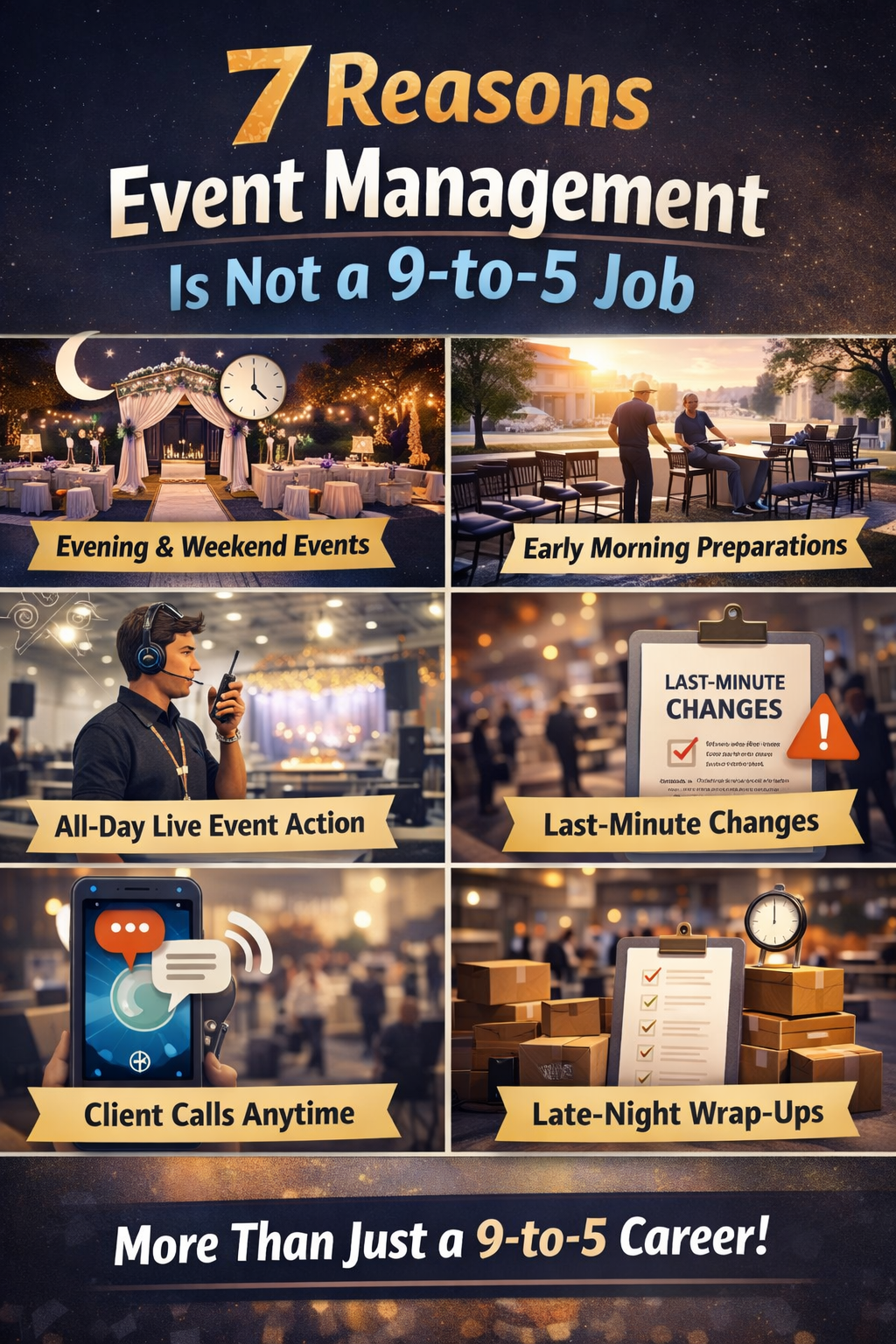
Here are 7 key reasons why event management does not fit into a 9-to-5 schedule.
One of the biggest reasons event management is not a 9-to-5 job is simple—events don’t happen between 9 a.m. and 5 p.m.
Most weddings, receptions, cocktail parties, concerts, exhibitions, and corporate celebrations take place:
In the evenings
Late at night
Early mornings
On weekends and holidays
Event managers must be available whenever the event takes place. This means working late nights, long weekends, and sometimes even consecutive days without breaks. In the event management industry, your schedule revolves around the event—not the clock.
Successful events are built long before the event day. Pre-event planning involves:
Venue visits and inspections
Vendor meetings
Décor trials
Technical rehearsals
Client presentations
These activities often depend on vendor availability, venue schedules, and client convenience. Many site visits happen early in the morning or late in the evening, especially at premium venues.
For anyone pursuing an event management career, flexibility is not optional—it’s essential. Planning work cannot be restricted to fixed hours because coordination with multiple stakeholders rarely aligns with a standard office schedule.
On the event day, there is no concept of logging off.
From the moment setup begins until the final guest leaves, event managers are constantly on their feet. Responsibilities include:
Managing décor and technical setup
Coordinating vendors and staff
Handling guests and VIPs
Ensuring timelines are followed
Solving last-minute challenges
An event day can easily stretch to 12–18 hours or more, especially for weddings and large-scale corporate events. This hands-on execution is what makes event management jobs dynamic—but also demanding.
No matter how perfectly an event is planned, last-minute changes are inevitable. Weather issues, technical failures, delayed vendors, guest list changes, or client requests can arise at any time.
Event managers must be prepared to:
Respond instantly
Make quick decisions
Coordinate solutions on the spot
These situations don’t follow a timetable. The ability to stay available and adaptable beyond regular working hours is a defining trait of professionals in the event management industry.
Clients are emotionally invested in their events—especially weddings and milestone celebrations. As the event date approaches, anxiety levels rise, and so does communication.
Clients may:
Call late at night for reassurance
Send messages with last-minute ideas
Request urgent changes or confirmations
Providing timely responses builds trust and confidence. For anyone serious about an event management career, client communication often goes beyond traditional office hours, especially during peak event seasons.
Many people assume the work ends when the event is over. In reality, post-event tasks are just as important.
These include:
Dismantling décor and technical setups
Managing inventory and returns
Vendor payment settlements
Feedback discussions and reviews
Internal team evaluations
Post-event work often happens late at night or the following day. In event management jobs, completion is not defined by time—it’s defined by responsibility.
The most successful professionals in event management are not driven by fixed schedules—they are driven by passion.
This industry attracts people who:
Enjoy creative challenges
Thrive under pressure
Love teamwork and coordination
Find satisfaction in seeing ideas come to life
For them, the long hours are not a burden but a part of the journey. The excitement of delivering a flawless event outweighs the absence of a traditional work routine.
While event management is not a 9-to-5 job, it offers rewards that traditional careers often don’t:
Real-world exposure
Rapid skill development
Strong networking opportunities
Creative satisfaction
High growth potential
Every event teaches something new—about people, planning, leadership, and problem-solving. This makes the event management industry ideal for individuals who want a dynamic and engaging professional life.
An event management career is perfect if you:
Prefer action over routine
Are comfortable with flexible hours
Enjoy managing people and situations
Can handle pressure gracefully
Are passionate about creating experiences
However, if fixed timings and predictable schedules are your priority, this industry may feel challenging.
Event management is not just a profession—it’s a lifestyle. It operates beyond fixed schedules, demands commitment, and rewards passion. From early morning planning to late-night executions, event management is truly not a 9-to-5 job.
For those who embrace flexibility, creativity, and responsibility, this career offers unmatched learning, excitement, and growth. If you’re ready to step outside the comfort of routine and into a world of live experiences, event management could be the perfect path for you.